AI MARKETS · CORPORATE FINANCIALS · CREDIT RISK
AI's $500 Billion Handoff: The Boom Just Moved Its Risk Into Your Pension
Demand is real, contracted, and accelerating. That was never the danger. In one week of August 2026 the AI buildout changed who pays if the machines age faster than the accounts assume — and broke six of the instruments built to watch it.
An August 2026 update to the AI Forensic Monitor.
PUBLISHED 2026-08-15 on LinkedIn. Article: https://www.linkedin.com/pulse/ais-500-billion-handoff-boom-just-moved-its-risk-your-kevin-blackman-zg1pf/ Feed post: https://www.linkedin.com/feed/update/urn:li:ugcPost:7494452370693746688/
Also distributed as an X post and a Substack note (same date).
Published with the cover image
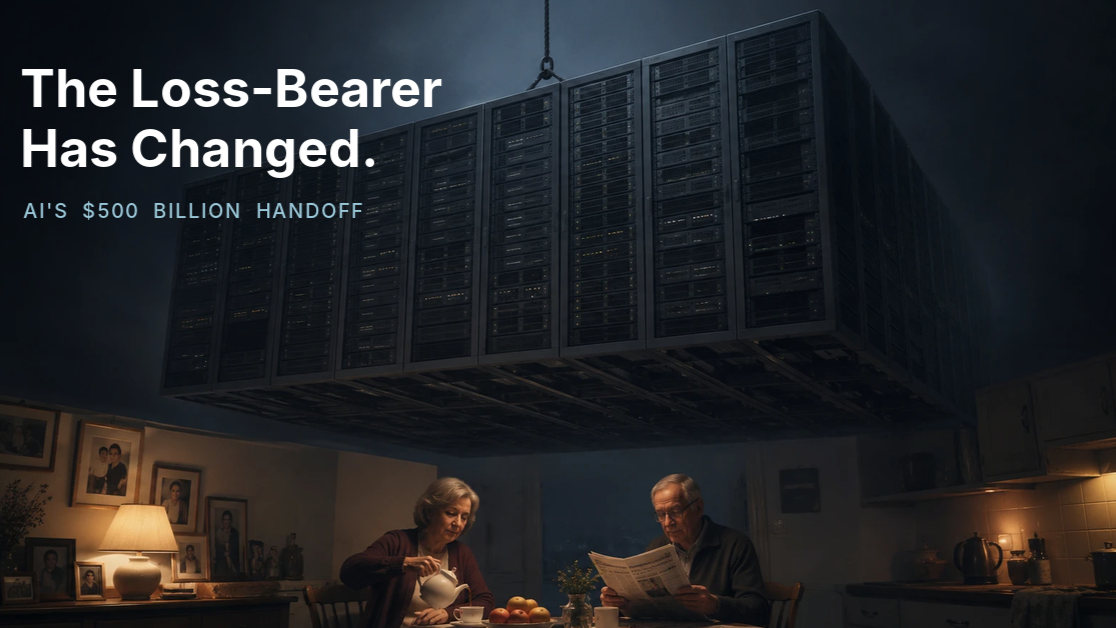
ai-bubble-monitor/img/cover2-loss-bearer.png("The Loss-Bearer Has Changed.") plus the inline images. The cover is the second generation: a suspended rack mass on a single rope above an ordinary kitchen, the couple unaware. The first generation (cover-loss-bearer.png) is retained but was not used. Appendices A and B were stripped before posting. This file is the source of record and is not revised after publication except to correct an error, which is logged at the foot.
The Short Version
The honest conclusion belongs at the top rather than at the end, because it is uncomfortable and burying it would be a way of dressing it up.
It is this: how this ends is not knowable, and after August 2026 it is less knowable than before — not because the news was bad, but because the things being measured stopped meaning what they used to mean.
Three developments landed in one week.
The AI specialists reported spectacular growth and deteriorating finances. Revenue at CoreWeave more than doubled while its losses widened, driven by interest on its debt. Demand is not the problem. Debt is.
Nvidia and six of the world's largest financial institutions signed agreements to set up $500 billion of financing that would move chip purchases into separate vehicles, off everyone's balance sheet, funded substantially by insurance and retirement capital. Nothing has been drawn yet: these are memoranda of understanding, an intention to raise, not capital deployed.
And Nvidia shipped a chip that undermines the resale value of the chips backing that financing — two days after guaranteeing a slice of that value itself.
Together these did something specific to the monitor. It is a set of numeric tripwires on published company accounts. Six of those tripwires now measure something other than what they were designed to measure — one of them, the central one, because the balance sheet it reads is being deliberately emptied.
So this is not a top call, and it is not an all-clear. The useful question has changed. It is no longer is the AI demand real — it is, and that argument is over. It is now: if this goes wrong, who pays? For most of this cycle the answer was shareholders of the richest companies on earth, who can afford it and who signed up for the risk. As of 10 August 2026 the answer is increasingly pension and insurance portfolios, which cannot, and did not.
That the instruments have been adapted around is itself the finding. The rest of this is how that happened.
The Demand Question Is Settled, and It Was Never the Danger
For eighteen months the argument about artificial intelligence has been a single question asked over and over. Is the demand real? Will companies buy enough AI to justify the several hundred billion dollars a year being spent building the machinery that produces it?
Between the 10th and 12th of August 2026, three sets of numbers answered it about as clearly as it can be answered. The answer is yes, embarrassingly so.
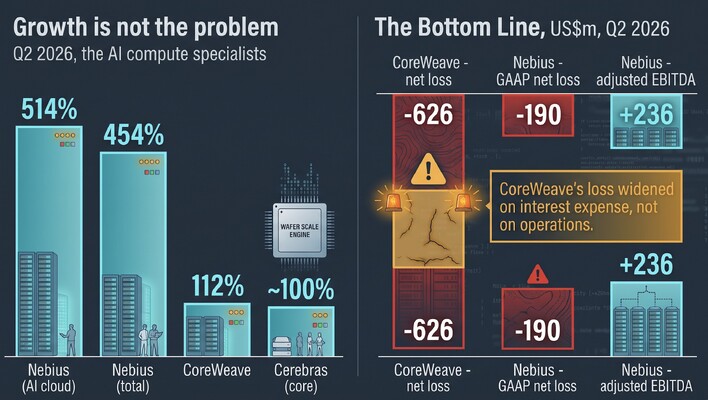
CoreWeave — which buys enormous quantities of AI chips and rents them out by the hour — grew revenue 112% in a year, to $2.58 billion in a single quarter. Its backlog, meaning contracts already signed and work already promised, stands at roughly $104 billion. It added a $21 billion agreement with Meta running to 2032, on top of $14 billion Meta had already committed, and a multi-year deal with Anthropic.
Nebius grew revenue 454%. Its AI cloud business specifically grew 514%. It closed four separate deals each worth more than a billion dollars in total contract value.
Cerebras roughly doubled revenue and raised guidance for the rest of the year.
These are not the numbers of a mirage. In the dot-com collapse — the comparison everyone reaches for — revenue decelerated first, and the accounting scandals came afterwards, as attempts to hide the deceleration. Here growth is accelerating, the contracts are signed, and the customers include the largest and best-capitalised companies on earth.
The bubble question, as normally posed, is settled in the boring direction. A different question is now the live one: if this hardware wears out or becomes obsolete faster than the paperwork assumes, who takes the loss?
Until the 10th of August the answer was Nvidia and a handful of the richest corporations in history. By the 12th it had begun to change.
Two Ways to Look More Profitable Without Earning More
Two pieces of accounting explain why the answer to that question matters. Both are entirely legal, both are ordinary, and both are load-bearing.
The van that has not been driven yet
Buy a delivery van for £50,000 and no £50,000 loss is recorded on the day of purchase. That would be silly — the van still exists. Instead the cost is spread across the years the van will be used. If it lasts five years, that is £10,000 a year. The annual charge is depreciation.
Here is the first mechanism. Depreciation starts when the asset is available for use, not when it is paid for. A van bought and parked on the forecourt, keys in hand, is depreciating from day one. A van still on the production line is not, because nobody can drive it yet. That is the distinction, and a half-built data centre is firmly the second van.
Does a van sitting on a lot for eight months really not lose value? Ask the tyres. Ask the seals, the brake discs, the upholstery quietly going green in the damp. Of course it does. The accounting simply has not been told yet. Which is the point of this section: physical decay and technological obsolescence run on the calendar, while the depreciation charge waits politely for the switch-on date.
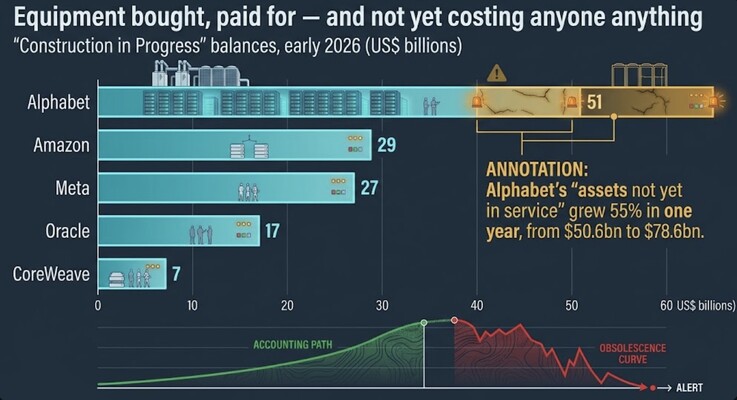
In corporate accounting that waiting room is called Construction in Progress. It is currently very full. As of early 2026 Alphabet carried roughly $51 billion of it, Amazon about $29 billion, Meta about $27 billion, Oracle about $17 billion. Alphabet's assets not yet in service grew 55% in a single year, from $50.6 billion to $78.6 billion.
Every one of those dollars is equipment already paid for, already booked as revenue and profit by the manufacturer, and already becoming technologically outdated — but not yet costing its owner anything on the profit line. When it is switched on, the charges begin. A draft internal report from the US Treasury makes precisely this point: current assumptions defer tens of billions of dollars of expense into 2027 and 2028. Fifty-one billion dollars of Alphabet's equipment is ageing in the rain right now. The profit line will not hear about it until 2027.
How long the van is said to last
The second mechanism is the number of years itself. Decide the van lasts ten years rather than five and the annual cost halves, from £10,000 to £5,000. Reported profit rises by £5,000 a year. Nothing about the van changed. Only the estimate did.
The AI companies have been lengthening these estimates steadily. Servers once depreciated over three to four years are now depreciated over five to six. Meta's extension to 5.5 years in 2025 reduced annual depreciation by roughly $2.9 billion — a 4% increase in reported pre-tax profit from an estimate revision alone. Alphabet's 2023 revision added $3.9 billion to pre-tax income. Microsoft's deferred $3.7 billion of expense.
In July 2026 Microsoft applied the same logic to a different asset class, extending the assumed life of its data centre and office buildings from 15 years to 25 years. The company's framing was that the change "affects only the timing of future depreciation." True, and precisely the point: it is already baked into the guidance investors are pricing.
The building may well last 25 years. But two-thirds of Microsoft's capital spending that quarter went into processors and graphics chips — the short-lived assets. The life extension was applied to the concrete, not to the silicon that dominates the spending and carries the obsolescence risk.
A J.P. Morgan stress test found that depreciating AI hardware over a realistic three years would cut earnings and operating margins across the major cloud providers by 6% to 15%.
Hundreds of billions of dollars of equipment, sitting in an accounting waiting room where it costs nothing, assumed to last five or six years, in an industry where the market-leading chip has been replaced roughly every eighteen months.
None of this is fraud. All of it is estimate. And an estimate is a place where a great deal of optimism can live without ever declaring itself.
Growth Is Not the Problem. Interest Is.
Return to those growth numbers and look at the bottom line instead of the top.
CoreWeave's revenue more than doubled. Its net loss got worse, widening to $626 million.
That combination is unusual and worth sitting with. A company whose sales double and whose losses deepen is usually failing to control its costs of production. That is not what happened. The driver was interest on its debt.
The business is to borrow money, buy AI chips, and rent them out. As it grows it borrows more. Rental income is growing fast. The interest bill is growing faster.
Nebius shows the same thing from the other side. In a quarter with $582 million of revenue it spent $5.66 billion on property and equipment — roughly ten dollars of spending for every dollar of revenue. On an adjusted basis it looks profitable, at positive $236 million. On the full statutory measure it lost $190 million.
Neither company has a demand problem. Both have a financing problem, and the first hides the second. Growth this fast has to be bought, and it is being bought with borrowed money at the moment borrowing is getting more expensive.
How much more expensive. The Federal Reserve held rates at 3.50–3.75% in July 2026 on a 9–3 vote, with three officials dissenting in favour of a rise — the first three-way unified dissent since 2016. The 30-year Treasury yield pushed past 5.19%, its highest since 2007. The market's assessment of the credit risk of the big technology companies themselves, measured by the cost of insuring their debt, has more than doubled since the start of 2025, sitting near 75 basis points for Oracle, Amazon, Alphabet and Microsoft. The widest in at least seven years.
The stock market's verdict was unambiguous. CoreWeave rose 19% and Nebius rose 34% after reporting. Investors saw doubling revenue and enormous backlogs and bought. They were not wrong to notice those things.
But the deterioration in these businesses is not appearing where anyone was watching for it. The watch was for idle chips. The chips are fully booked. The interest is eating the returns.
The Week the Risk Moved
On 10 August 2026 Nvidia announced agreements with six of the largest financial institutions in the world — Apollo, BlackRock, Blackstone, Brookfield, Goldman Sachs and KKR — to create financing platforms mobilising more than $500 billion for AI infrastructure.
Stripped of the language, the mechanism is this.
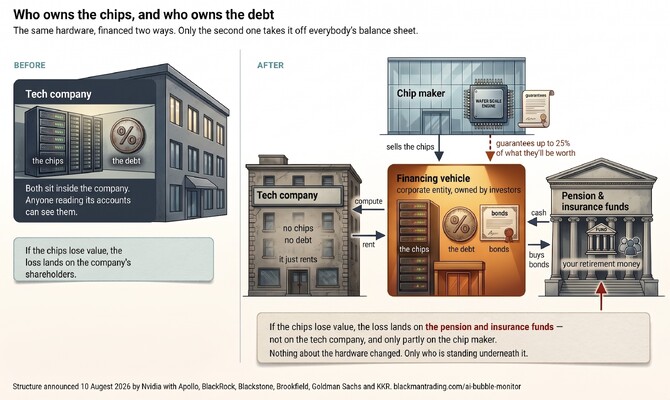
Until now, a company that wanted a billion dollars of AI chips bought them. The chips went onto its balance sheet, the debt went onto its balance sheet, and anyone reading the accounts could see both.
Under the new structure a separate financing vehicle — legally distinct, owned by investors, not by Nvidia and not by the customer — buys the chips and the data centre. The AI company leases the computing power from that vehicle. The vehicle issues bonds to raise the money, and the chips themselves are the collateral behind those bonds.
Jensen Huang described the logic directly: Nvidia's chips have become revenue-generating infrastructure, "an investable asset" comparable to commercial property or power grids. Nvidia holds an option to provide up to $125 billion of backstop, or residual-value, support — roughly 25% of the total — meaning that if the chips prove worth less than the loans assume, Nvidia absorbs a slice of the shortfall.
Where the $500 billion comes from matters. Only one of the six partners is a bank. The other five are alternative asset managers, and the capital they deploy is long-duration institutional and insurance money — pension funds, annuity books, retirement savings. Money whose defining characteristic is that it is supposed to be safe.
This has been widely reported as Nvidia de-risking the buildout, and as an answer to the criticism of circular financing — the concern that Nvidia has been investing in the customers who then buy Nvidia chips, so that some of its revenue is its own money coming back around. Morgan Stanley took that view: outside investors now supply most of the capital, so the circle is broken.
That reading does not survive contact with the details. Three reasons.
The circle is relocated, not broken. Retaining residual-value support on up to 25% of projects means Nvidia still absorbs the first loss on precisely the risk that matters — that its chips are worth less in five years than everyone assumed. Ben Thompson put it more sharply: a residual-value guarantee is "in a certain sense, a price cut." If that is right, it is a discount that never appears in Nvidia's selling prices or margins. It appears, if it ever appears, years later, as a payout.
The structure makes the spending invisible. Every dollar of chips bought through one of these vehicles is a dollar that never appears in any AI company's capital spending, and never enters the accounting waiting room. The equipment is there. The obligation is there. The line item is not.
That is not speculation about what might happen. A smaller version happened in public three weeks earlier. In July Microsoft's headline capital spending guidance for 2026 fell from about $190 billion to about $175 billion, with no change to its actual spending plans. The reduction was a classification effect: future data centre leases moving from a category that counts in the headline number into one that does not. Roughly $15 billion of real spending left the headline while remaining fully committed.
That was $15 billion, at one company, by reclassification. The new platforms propose $500 billion, industry-wide, by design.
This is the structure that broke in 2008. That comparison gets thrown around lazily, so the specific claim is narrow. What made the financial crisis a crisis rather than a bad year for housing was the use of separate legal vehicles to hold long-lived, hard-to-sell assets, funded by borrowing, in a way that kept the leverage off the balance sheets of the institutions that originated it — until it came back. Those vehicles were called SIVs. The asset managers now originating most AI data-centre private credit — Blackstone, Apollo, BlackRock, Blue Owl, Pimco — are largely the same firms.
This is not a prediction of 2008. The underlying asset here generates real revenue from real customers under signed contracts, which subprime mortgages did not. The point is narrower and harder to argue with: the structure determining who absorbs a loss, if a loss occurs, is now the same structure. And the party at the end of that chain has changed from technology shareholders, who signed up for volatility, to insurance and retirement portfolios, which did not.
Thompson again: "It's one thing to spend all of your free cash flow; it's another thing to tap the debt markets."
For scale. AI-related debt issuance is tracking toward roughly $570 billion in 2026, more than double 2025. Amazon, Alphabet, Nvidia, Meta, Oracle and SpaceX alone have issued $182 billion of investment-grade bonds this year — up 1,300%, and about 15% of every corporate bond issued in the United States. All of that before a single dollar flows through the new vehicles.
One event will settle whether any of this is real, and it is worth watching for by name: the first bond actually issued by one of these vehicles. Until a special purpose entity prices a deal, draws the capital and buys the hardware, the $500 billion is an intention rather than a flow, and the accounting problem it creates is a risk rather than a fact. That issuance is the checkpoint. It is the moment the reported capital spending figures stop describing the buildout, and the moment the loss path set out here goes from designed to live.
The Chip That Eats Its Own Collateral
Hold that word collateral, because a second development two days later has been discussed almost entirely separately from the first. That separation is the most interesting thing about it.
In December 2025 Nvidia paid about $20 billion to license the technology of a company called Groq and to hire its founder Jonathan Ross and its president Sunny Madra. In March 2026 the result shipped: the Groq 3 LPU, or Language Processing Unit.
The LPU is not a graphics chip. It does one job — running AI models rather than training them — and it does that job with a fundamentally different memory design, keeping working data on the chip itself instead of in external high-bandwidth memory. The claimed results are startling: about 150 terabytes per second of memory bandwidth, roughly seven times the 22 TB/s in Nvidia's flagship Rubin graphics chips, and 1 to 3 joules of energy per word generated against 10 to 30 for graphics-chip-based systems, roughly ten times more efficient. Nvidia claims around 35 times the throughput per megawatt. OpenAI has committed to 3 gigawatts of capacity on the platform.
Now place the two announcements side by side, two days apart.
Nvidia is offering to guarantee the residual value of graphics chips while shipping the product that most credibly erodes the residual value of graphics chips in the single largest category of work they do.
Those two facts have not appeared in the same sentence anywhere in the coverage. They belong there. The bonds these financing vehicles will issue are secured on the future worth of AI hardware. If purpose-built inference chips are ten times more energy-efficient at the task that is supposed to absorb the existing fleet once the training boom matures, the future worth of that fleet is a more open question this August than it was last year.
The second-order point is the genuinely novel one.
The monitor had always assumed an efficiency breakthrough would arrive from outside — an open-source model like DeepSeek, showing the same results for a fraction of the computing power, and damaging Nvidia. That is not what happened. The breakthrough arrived from inside, and Nvidia bought it, paying $20 billion to own the disruption of its own franchise before anyone else could inflict it.
The consequence is subtle and important. Nvidia's revenue is protected. The obsolescence risk is not eliminated — it is transferred. It sits with whoever owns the previous generation of hardware: the specialist rental companies, the data centre operators, and now the bondholders financing them. Efficiency risk and credit risk have been separated from one another and assigned to different parties.
An efficiency shock should no longer be described as bad news for Nvidia. It is bad news for Nvidia's customers, and for their creditors.
The honest counter-argument deserves weight. Cheaper output may simply mean far more of it — a well-documented pattern in which making something dramatically cheaper raises total spending on it, because uses that were previously uneconomic become viable. If that holds, efficiency is fuel rather than threat.
Nvidia argues something stronger still, and in a direction that contradicts the efficiency thesis outright: that providers using LPU racks could charge up to $45 per million words of output, roughly three times OpenAI's current rate of about $15, because the speed unlocks premium applications nobody can offer today.
Both cannot be true. Either efficiency drives the price of AI output down, undermining the economics of the installed hardware, or it drives revenue per unit up, strengthening them. Which one holds is unresolved, and it is now the single most important open question for anyone valuing this infrastructure.
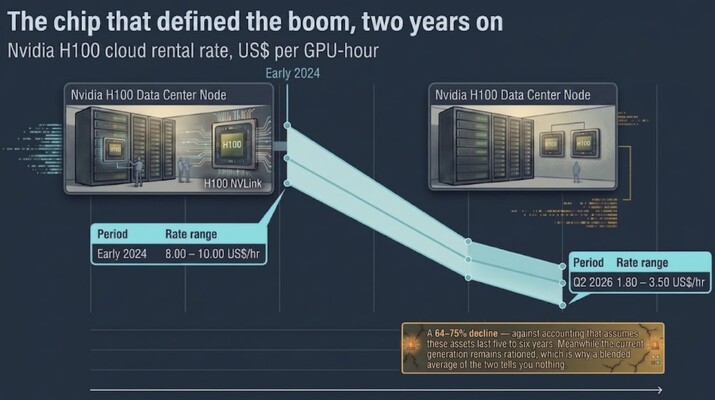
One real-world data point cuts toward the first answer. The rental price of the H100 — the chip that defined the 2023–24 boom — has fallen from $8–10 per hour in early 2024 to roughly $1.80–3.50 by mid-2026, a decline of 64–75%. Some of that is competition; more than 300 new providers entered the market. But a two-to-four-year-old chip losing three-quarters of its rental value is a hard fact about how fast this equipment ages, sitting directly beside accounting that assumes five to six years.
Six Instruments, and What Each One Now Measures
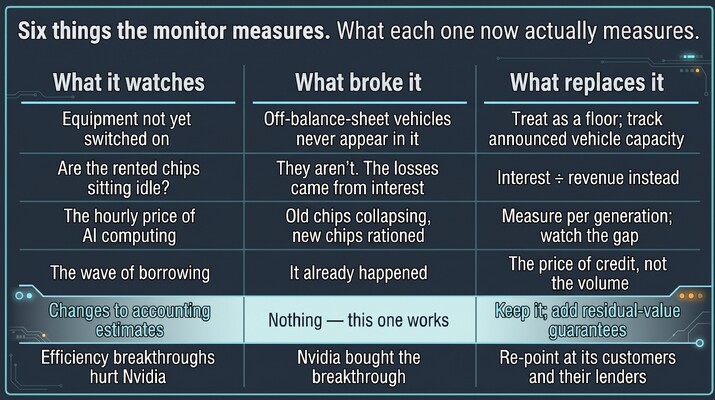
The AI Forensic Monitor is a set of specific numeric tripwires, each with a threshold that, when crossed, says something has changed. The August events did not merely add data to those tripwires. They broke six of them, in the specific sense that the instrument now measures something other than what it was designed to measure.
Setting that out plainly, including where the monitor was wrong, matters — a framework that only ever confirms itself is decoration.
One — construction in progress as a share of total equipment
The design: if not-yet-switched-on equipment exceeds 35% of total equipment across the major cloud companies, the deferred depreciation wave has become large enough to matter.
What broke it: equipment bought through the new financing vehicles never enters this number. Neither does spending reclassified between lease categories, as Microsoft demonstrated with roughly $15 billion. The measure reads a balance sheet that is being deliberately emptied.
The amendment: track announced third-party and vehicle-financed capacity alongside reported figures, and treat every reported capital spending number as a floor, not a measurement.
Two — debt service coverage at the specialist rental companies
The design: watch utilisation rates and rental prices at CoreWeave, Nebius and their peers. If the chips sit idle or hourly rates collapse, the debt cannot be serviced.
What broke it: utilisation is fine. Rental demand is fine. Backlogs are at record highs. And CoreWeave's losses widened anyway, because of interest. The wrong end of the income statement was under observation. The thesis was right — these companies fail through their debt — and the instrument was wrong, because it looked for that failure in demand.
The amendment: the primary reads for this cohort are now interest expense as a share of revenue and the gap between adjusted profit and statutory profit. Both are large and widening at both major players. This is the most immediately actionable of the six.
Three — the rental price of computing power
The design: a sustained fall of more than 15% over three months in hourly AI computing rates signals oversupply.
What broke it: the H100 is down 64–75% while the newest chips are so scarce customers wait months. A blended average conflates a collapsing old generation with a rationed new one, and reports the average as calm. The averaging destroys the signal it was built to catch.
The amendment: measure per generation, and treat the spread between current-generation and previous-generation rates as the indicator. A widening spread is the obsolescence signal. A narrowing one means the new generation's scarcity premium is fading.
Four — the wave of borrowing
The design: technology sector debt and equity issuance above $600 billion in a calendar year marks the late-cycle scramble for capital.
What broke it: nothing. It worked, and it has essentially fired. $182 billion of investment-grade bonds from six companies, $570 billion of AI-related issuance tracking for the year, 15% of all US corporate bond issuance. A threshold that has been reached stops being an early warning and becomes a description of the present.
The amendment: promote the live read from volume to price — credit spreads and default-insurance costs, near 75 basis points and at seven-year highs, Oracle widest. Volume says the borrowing happened. The spread says what lenders now think of it.
Five — changes to accounting estimates
The design: any further extension of assumed asset lives, or any headline spending reduction arising from reclassification rather than from spending less, is a warning.
What broke it: nothing. This one is working exactly as designed, and caught Microsoft's 25-year building life and its lease reclassification cleanly. It has since been corroborated by the Treasury's own draft analysis and by a Federal Reserve survey in which market participants named debt-funded data centre spending as a systemic risk. The accounting critique is no longer a contrarian position. It is the official-sector one.
The amendment: keep it, and add residual-value guarantees as an event of the same class. A guarantee is an estimate revision made by someone else on your behalf.
Six — efficiency breakthroughs
The design: a dramatic improvement in AI efficiency reduces the need for computing power, hurting Nvidia.
What broke it: the direction. The breakthrough came from Nvidia, which paid $20 billion for it. Nvidia's revenue is insulated. The damage lands on owners of the previous generation and on their lenders.
The amendment: re-point the instrument from Nvidia to the rental companies, the data centre operators and the new bondholders, and track the realised price of AI output against Nvidia's own claim that efficiency will raise it to $45 per million words. That single number is the cleanest available test of which of the two contradictory theses is right.
What Follows, and Why
Held with reasonable confidence:
The demand is real and contracted. There is no demand mirage to argue; the evidence against one is overwhelming and ignoring it would mean ignoring the monitor's own data.
The deterioration is in financing, not demand. It appeared first, and unambiguously, in an interest expense line. That is where it will continue to appear.
The measurement problem is now the central problem. Between lease reclassification and third-party vehicles, the reported figures for what this buildout costs are becoming systematically understated. Not a prediction — it has already happened twice, in public, by design.
The identity of the loss-bearer has changed, and that change is not yet widely priced or discussed.
Not known, and not worth pretending:
Whether cheaper inference expands total spending or contracts it. Nvidia's $45-per-million projection and the efficiency thesis are in direct contradiction and cannot currently be resolved.
Whether the enterprise middle of the market inflects on the timeline five-year capacity contracts assume. Amazon's chief executive was asked and conceded, unprompted, that he did not know whether that segment would follow the same steep trajectory — still the most revealing sentence any executive has said about this cycle.
When the deferred depreciation actually lands. The Treasury draft says 2027–2028. That is an estimate about estimates.
What changes in the monitor:
No top call and no all-clear. Both would be claims the instruments can no longer support, and pretending otherwise would be the actual failure.
The centre of gravity moves from the balance sheet to the credit markets. The balance sheet is being emptied by design. The credit markets are where the risk went and where it must now be priced. Concretely: spreads over volumes, interest coverage over utilisation, per-generation rental spreads over blended averages.
Reported capital spending numbers are treated as a floor. Any analysis taking them at face value from here is measuring an artefact.
Residual value is the load-bearing question. Whether GPUs hold their worth determines simultaneously whether the depreciation schedules are honest, whether the new bonds are sound, and whether Nvidia's guarantee is a formality or a liability. One question, three answers.
Final Thought
Each of these events was an adaptation by intelligent, well-advised people to the scrutiny that preceded it. Depreciation schedules lengthened after margins came under pressure. Leases were reclassified after headline capital spending drew attention. Financing is being moved off balance sheets after circular-financing criticism landed. Each adaptation degraded a measure the monitor relied on — not by breaking a rule, but by making the number mean something different.
There is no reason to expect that to stop, and no version of this where a better tripwire settles the matter. The correct posture is to assume that any monitor which becomes well known will be adapted around, and to anchor on the one question structures do not change: if this goes wrong, who pays?
For most of this cycle the answer was shareholders of the richest companies in the world, who can afford it and who signed up for the risk.
As of the 10th of August 2026 the answer is increasingly pension and insurance portfolios, which cannot, and did not.
That is the development worth watching. Not because a crash is coming — there is no basis for saying so and it is not being said — but because the consequences of being wrong have quietly been moved onto balance sheets that were chosen for their safety.
All figures from company Q2 2026 earnings releases and calls, Nvidia and Groq product and partnership announcements, FOMC statements, US Treasury and Federal Reserve publications, and GPU cloud market rate surveys, as of 15 August 2026. Interpretations are flagged in the text where they are interpretations rather than reported fact — specifically that the financing platform relocates rather than resolves circular financing, that the Groq launch and the residual-value guarantee are in tension, and that the efficiency shock has been transferred to customers rather than absorbed by Nvidia. Ben Thompson's characterisation of residual-value support as a price cut is his reading, quoted because it is persuasive, not because it is established. The contradiction between Nvidia's $45-per-million-token projection and the efficiency thesis is unresolved and presented as unresolved. The full monitor, including its tripwire thresholds and prior quarterly updates, is at blackmantrading.com/ai-bubble-monitor.
Hashtags
Recommended for LinkedIn — use 5 to 8. More than that suppresses reach. Ordered strongest first.
#AIInfrastructure #CreditRisk #PrivateCredit #DataCenters #CorporateFinance
#Nvidia #AIBubble #InstitutionalInvesting
Copy-paste, 5 tags (recommended):
```
AIInfrastructure #CreditRisk #PrivateCredit #DataCenters #CorporateFinance
```
Copy-paste, 8 tags (wider net):
```
AIInfrastructure #CreditRisk #PrivateCredit #DataCenters #CorporateFinance #Nvidia #AIBubble #InstitutionalInvesting
```
Reasoning, since tags reward specificity over volume:
- #AIInfrastructure, #DataCenters — where the practitioner audience is. Broad
#AIis far too saturated to reach anyone; skip it. - #CreditRisk, #PrivateCredit — the differentiated angle. Most AI commentary never touches credit, so these put the piece in front of a smaller, better-matched audience with almost no competing content.
- #CorporateFinance — carries the accounting half: depreciation, CIP, lease classification.
- #Nvidia — high volume, high noise. Worth including because the piece makes a specific Nvidia claim, but it will not drive reach.
- #AIBubble — attention-grabbing and polarising, and the article deliberately declines to call a bubble. Include it to have the argument; drop it to have the readers.
Appendix A — publishing notes (delete before posting)
LinkedIn Articles on a free account: yes. Articles are available on the free tier; Premium is not required. "Write article" from the home feed opens the publishing editor.
Inline images in a LinkedIn Article: yes. Articles support a cover/banner image plus inline images throughout the body, each with an optional caption. That is the reason to use an Article rather than a feed post here — feed posts allow only limited images and truncate long text behind a "see more" fold. Articles also allow inline hyperlinks, which this piece needs.
Two practical constraints:
- The LinkedIn editor does not accept Markdown. Pasting this file directly renders literal
##and**characters. Paste the text, then apply Heading 1 / Heading 2 / quote / bold from the editor's toolbar — about ten minutes. Substack accepts Markdown paste directly and preserves formatting. That is the trade-off between the platforms; it is formatting friction, not reach. - Length is not a constraint. This runs ~35,000 characters against LinkedIn's ~110,000 limit for Articles. The constraint is reader patience, not the platform.
Suggested accompanying feed post — LinkedIn favours articles shared with a native post over ones published silently:
Everyone is arguing about whether AI demand is real. The August numbers settle it — CoreWeave's revenue doubled, its backlog hit $104bn, and its losses got worse.
Demand was never the interesting question. The interesting question is who takes the loss if the hardware ages faster than the accounting assumes. In one week, that answer started changing from "Nvidia and Big Tech" to "insurance and pension portfolios."
New update to the AI Forensic Monitor: what happened, why it broke six of the measures the monitor runs on, and what changes as a result. No crash prediction — the honest conclusion is that the cycle is now less legible than it was, and that is the finding.
Appendix B — image specifications and prompts (delete before posting)
Six images. Four are data charts, two are conceptual. The distinction matters: for the charts, do not use an image generator — generators invent numbers and axis labels, and a fabricated figure in a data-driven article is fatal to it. Build those four in a spreadsheet, Datawrapper or a plotting library from the exact values below, then export as PNG. Only Images 1 and 4 go through a generator.
Keep one visual identity across all six: one accent colour, one neutral grey, white or very dark background, no gradients, no 3-D, no clip-art. LinkedIn renders roughly 1200 × 628 for the cover and up to 1200px wide inline. Make text large enough to survive mobile.
IMAGE 1 — cover / hero (image generator)
Placement: top of article, before "The Short Version".
Prompt:
A wide editorial illustration, 1200x628, minimalist and restrained, in the visual language of a serious financial newspaper. A conveyor belt or relay handoff carrying stacked server racks and silicon wafers, moving from a group of glass corporate towers on the left toward a plain, solid, institutional stone building on the right — the kind that reads as an insurance company or pension fund. The handoff point is the visual centre. Muted palette: deep navy, warm grey, a single accent of amber. Flat vector style, clean geometry, generous negative space, no text, no logos, no faces, no futuristic or sci-fi elements, no glowing blue circuitry cliches.
Caption: The chips are the same. The balance sheet holding them is not.
IMAGE 2 — the accounting waiting room (build from data)
Placement: in "Two Ways to Look More Profitable", at "The van that has not been driven yet".
Type: horizontal bar chart.
Title: Equipment bought, paid for — and not yet costing anyone anything Subtitle: "Construction in Progress" balances, early 2026 (US$ billions)
| Company | CIP (US$bn) |
|---|---|
| Alphabet | 51 |
| Amazon | 29 |
| Meta | 27 |
| Oracle | 17 |
| CoreWeave | 7 |
Annotation on the chart: Alphabet's "assets not yet in service" grew 55% in one year, from $50.6bn to $78.6bn.
Source line: Company 10-Q/10-K filings, early 2026.
IMAGE 3 — revenue up, losses up (build from data)
Placement: opening "Growth Is Not the Problem. Interest Is."
Type: two panels side by side, same height. The visual contradiction between them is the point.
Title: Growth is not the problem Subtitle: Q2 2026, the AI compute specialists
Left panel — revenue growth, year on year:
| Company | YoY growth |
|---|---|
| Nebius (AI cloud) | 514% |
| Nebius (total) | 454% |
| CoreWeave | 112% |
| Cerebras (core) | ~100% |
Right panel — the bottom line, US$m, Q2 2026:
| Company | Figure |
|---|---|
| CoreWeave — net loss | −626 |
| Nebius — GAAP net loss | −190 |
| Nebius — adjusted EBITDA | +236 |
Annotation: CoreWeave's loss widened on interest expense, not on operations.
Source line: Company Q2 2026 results.
IMAGE 4 — the old way and the new way (image generator, or draw it manually)
Placement: in "The Week the Risk Moved", after the mechanism is described.
The most useful image in the piece and the easiest to get wrong. If the generator produces something muddled, draw it in any diagram tool — structure matters more than polish.
Prompt:
A clean two-panel side-by-side comparison diagram, flat vector infographic style, no photorealism, 1200x800. Left panel labelled "Before": a single box representing a technology company, with server racks and a debt symbol both clearly inside that box. Right panel labelled "After": three separate boxes connected by arrows — a technology company on the left, a separate detached vehicle in the middle holding the server racks and issuing bonds, and on the right a group of institutional investors labelled as pension and insurance funds. An arrow from the tech company to the middle box labelled "leases compute"; an arrow from the investors to the middle box labelled "buys bonds"; a dotted arrow from the middle box back to a chip manufacturer labelled "residual value guarantee". Restrained palette, navy and grey with one amber accent, clear labels, no clutter, no 3-D.
Caption: Same chips, same obligation. In the second structure it appears on nobody's balance sheet — and the loss, if there is one, lands somewhere new.
IMAGE 5 — what a two-year-old chip is worth (build from data)
Placement: in "The Chip That Eats Its Own Collateral", near the H100 discussion.
Type: slope or line chart showing the fall, with a shaded band for the range.
Title: The chip that defined the boom, two years on Subtitle: Nvidia H100 cloud rental rate, US$ per GPU-hour
| Period | Rate range (US$/hr) |
|---|---|
| Early 2024 | 8.00 – 10.00 |
| Q2 2026 | 1.80 – 3.50 |
Annotation: A 64–75% decline — against accounting that assumes these assets last five to six years. Meanwhile the current generation remains rationed, which is why a blended average of the two tells you nothing.
Source line: GPU cloud market rate surveys, 2024–2026.
IMAGE 6 — six instruments (build as a table graphic)
Placement: opening "Six Instruments, and What Each One Now Measures".
Type: a clean table image, six rows, three columns. No chart. Legibility is everything — this is the reference visual people screenshot.
Title: Six things the monitor measures. What each one now actually measures.
| What it watches | What broke it | What replaces it |
|---|---|---|
| Equipment not yet switched on | Off-balance-sheet vehicles never appear in it | Treat as a floor; track announced vehicle capacity |
| Are the rented chips sitting idle? | They aren't. The losses came from interest | Interest ÷ revenue instead |
| The hourly price of AI computing | Old chips collapsing, new chips rationed | Measure per generation; watch the gap |
| The wave of borrowing | It already happened | The price of credit, not the volume |
| Changes to accounting estimates | Nothing — this one works | Keep it; add residual-value guarantees |
| Efficiency breakthroughs hurt Nvidia | Nvidia bought the breakthrough | Re-point at its customers and their lenders |
Styling note: set row five in the accent colour. That it is the one instrument still working as designed is the honest note the graphic needs.
End of appendices. Delete Appendix A, Appendix B and the six [IMAGE n] markers before publishing.
Post-publication log
- 2026-08-15, after publication - cover swapped to
cover2-loss-bearer.png(clearer mass, single suspending rope, cleaner space for the headline). Distribution extended to an X post and a Substack note. - 2026-08-15, after publication - added the SPE bond issuance checkpoint to "The Week the Risk
Moved": the first bond actually issued by one of the vehicles is what converts the $500B from
intention into flow. Applied to the published LinkedIn version as well, together with the two
tense corrections below, so this file remains the source of record. Tracked as
[R72]in the public reference log. - 2026-08-15 — published to LinkedIn (links above). Immediately before posting, the tense on the
Nvidia financing platforms was corrected across the article, the public dashboard and the
reference log. The 10 August announcement was memoranda of understanding to establish platforms
intended to mobilise over $500B; no vehicle has issued a bond, drawn capital or acquired
hardware. Earlier drafts read as though the money had already moved. The published text carries
the "nothing has been drawn yet" caveat. The checkpoint that would convert the claim from
announced intent into observed flow is tracked as
[R72]in the public reference log: the first actual SPE bond issuance. - 2026-08-16 — depreciation passage corrected, applied to the published LinkedIn version. A
reader (Ant, QD Discord) correctly objected that the van analogy in "The van that has not been
driven yet" was wrong as written: depreciation does not wait for an asset to be used, it starts
when the asset is available for use. A van bought and parked on the forecourt depreciates from
day one. The mechanism the article describes is real — Construction in Progress genuinely is not
depreciated — but the analogy pointed at the wrong van. Rewritten to distinguish the parked van
(depreciating) from the half-built van (not), with the physical-decay aside kept as the point
rather than conceded: obsolescence and wear run on the calendar while the depreciation charge
waits for the switch-on date. The "ageing in the rain" image moved to the end of the CIP paragraph
so it lands on Alphabet's $51B rather than on a hypothetical. No figure or conclusion changed.
Source thread archived at
docs/research/ai-bubble-monitor/discussion/2026-08-16_discord_thread_who_is_holding_the_bag.md.